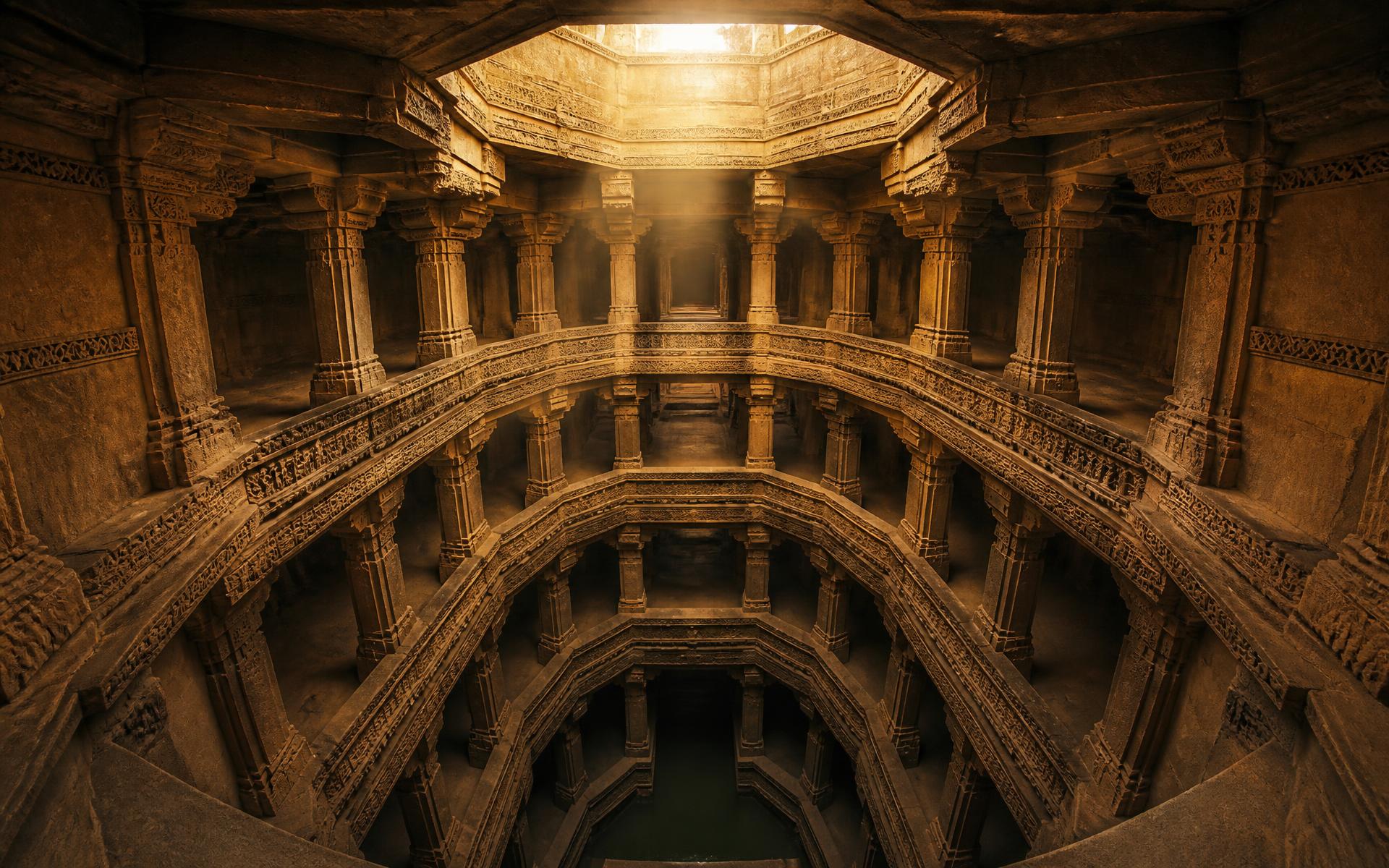
Looking down into the five carved storeys of Adalaj Stepwell with light falling from above

Adalaj · Gujarat · India

A Descent Into Architecture & Devotion

Five storeys of Indo-Islamic brilliance, carved in sandstone, 1498 CE.

1498 CE
Year completed
5
Subterranean storeys
5–6 °C
Cooler than surface
₹5 lakh
Cost of that era

The Origins

A king's promise, a queen's grief

Built in 1498 CE during the reign of the Vaghela dynasty, Adalaj Stepwell was commissioned by Rana Veer Singh to answer the water needs of his drought-stricken region, Dandai Desh. After the king fell in battle against Sultan Mahmud Begada, his widow Queen Rudabai completed the construction under the Sultanate of Gujarat.

Legend says Rudabai accepted the Sultan's marriage proposal on the condition that he finish the stepwell — but once it was complete, she plunged into its waters to meet her husband in death, leaving this marvel behind for her people.

An inscription on the first storey (Samvat 1555 / 1498 CE) records a construction cost of five lakh rupees of that era and honours the queen — earning the well its other name, "Rudabai ni Vav".
The Art & Science

Engineering disguised as ornament

Indo-Islamic Fusion

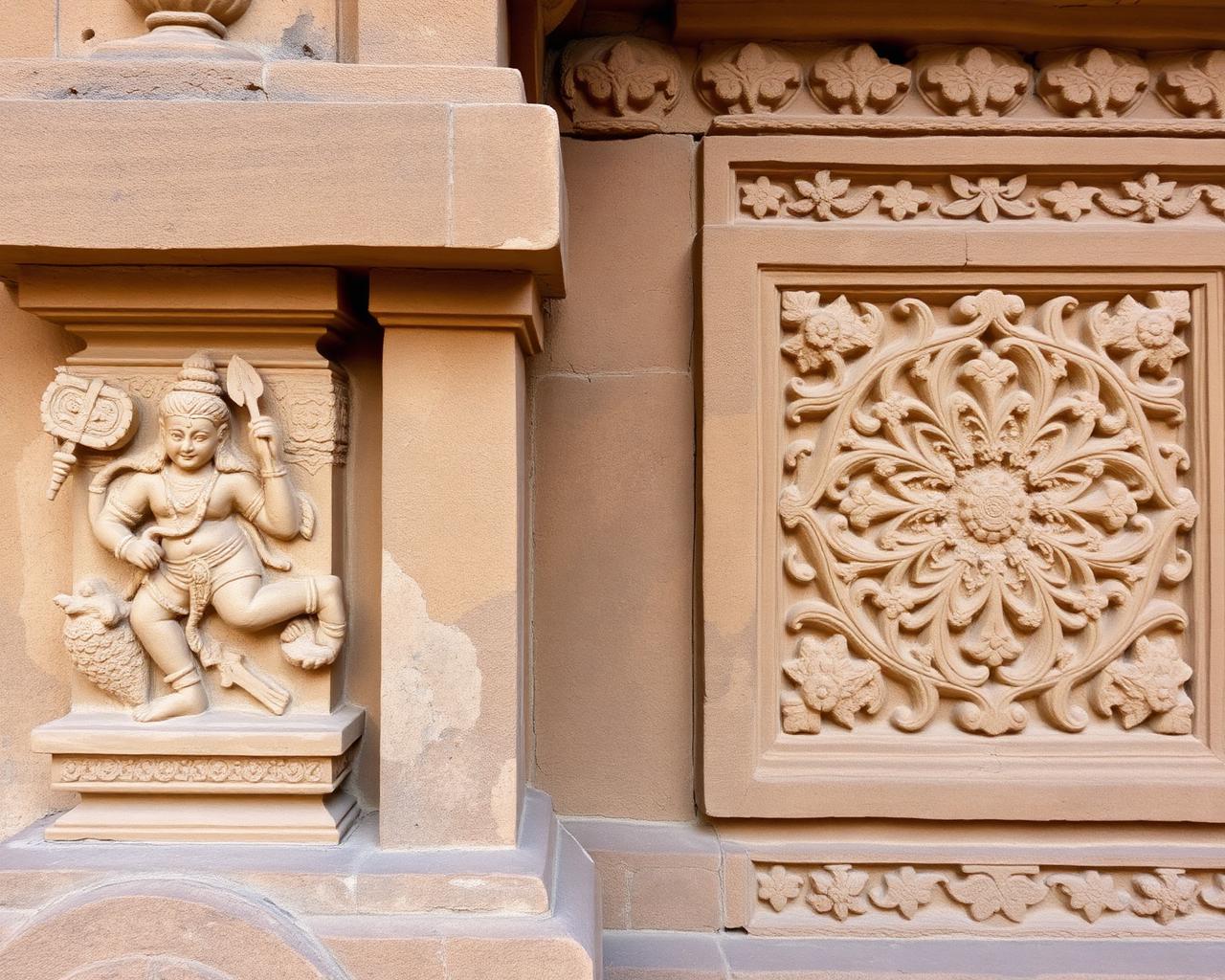
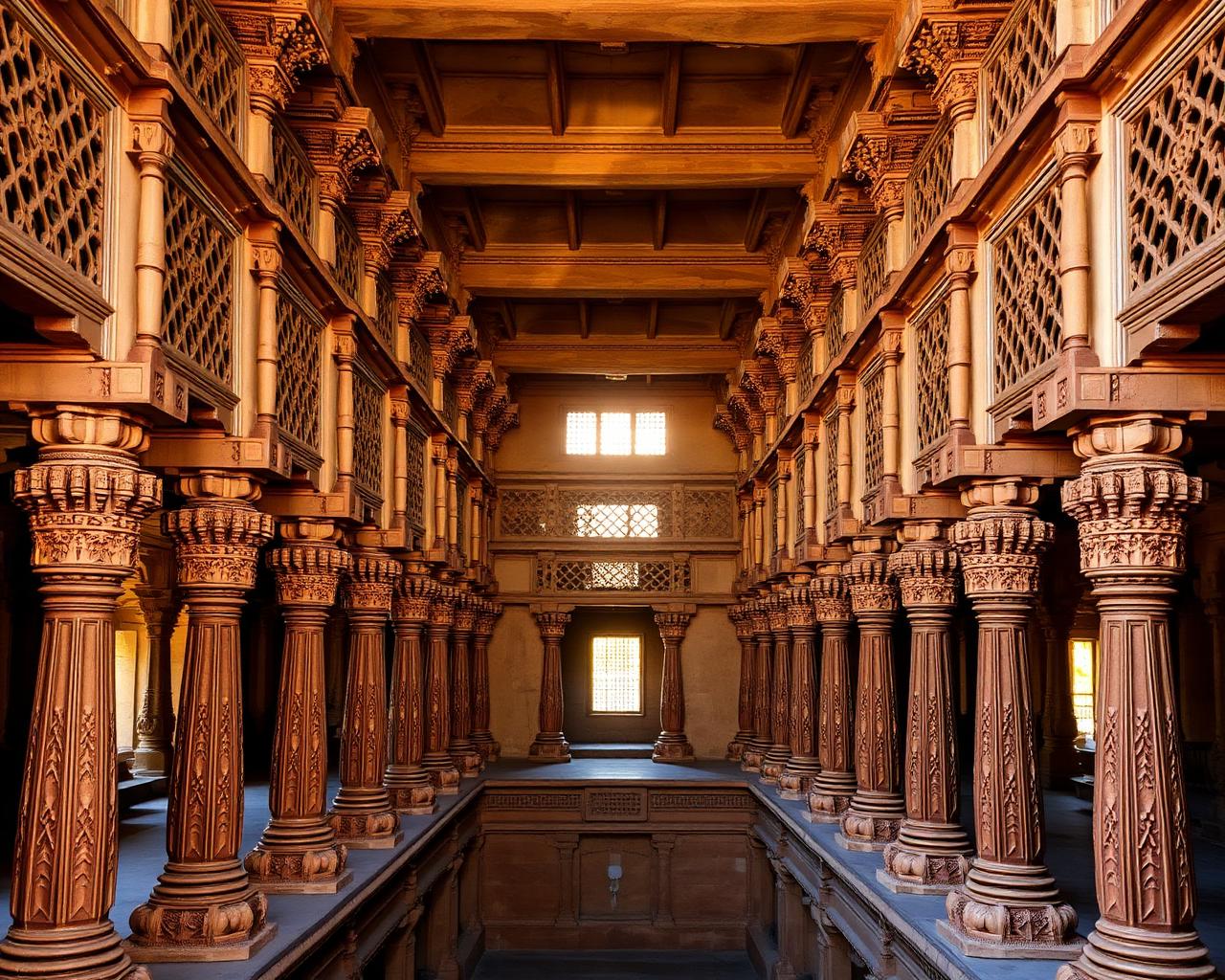
Solanki-style columns and Hindu & Jain deities — Ganesha, Parvati, Bhairava — meet Islamic geometry, floral vine motifs, Arabic calligraphy and lattice arches. Three staircases converge on a vast square platform at the first underground storey.

The Hindu

Natural Air-Conditioning

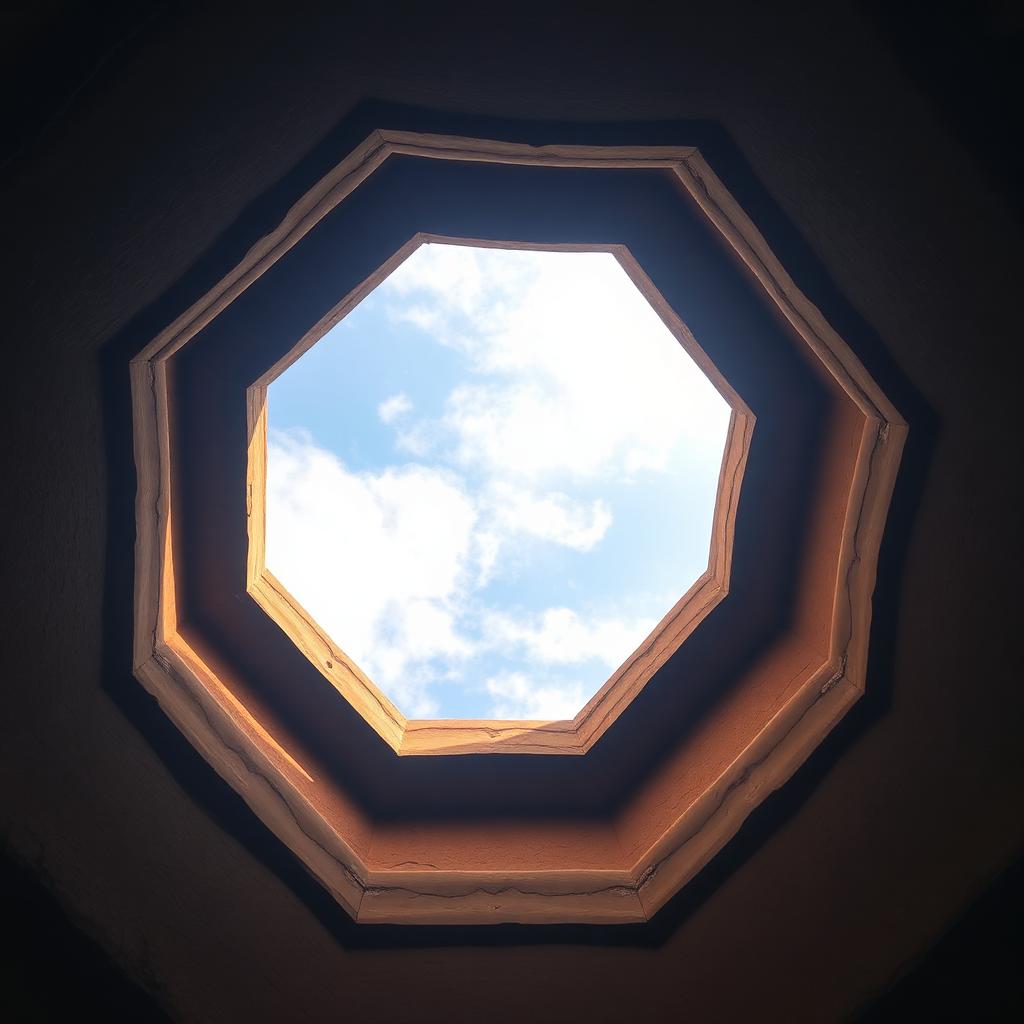
The subterranean structure holds 5–6 °C cooler than the surface all year. Octagonal openings at each level meter light and air while sandstone mass and depth do the passive cooling — a refuge from Gujarat's ferocious summers.

Studio Matrx

Intricate Carvings

Pillars and beams carry the Kalp Vriksha (Tree of Life) and Ami Khumbor (sacred water pot), alongside deities, mythological figures and ornament. Every storey reveals new patterns — a living museum of 15th-century craftsmanship.

Wikimedia Commons

Rows of carved Solanki-style sandstone columns and lattice jali screensOctagonal opening in the stepwell roof framing the sky

Why it is a global marvel

Where two building cultures met

Photographers, architects and historians hold Adalaj to be perhaps the finest example of Indo-Islamic stepwell architecture in Gujarat. Its three-staircase design, five-storey octagonal plan and seamless fusion of Hindu-Jain symbolism with Islamic geometry make it a rare site where several architectural traditions coexist harmoniously.

Architects admire how it distils the entire achievement of the Indian stepwell — hydraulic engineering, passive cooling, communal space and profuse sculpture — in a single sunken structure, raised at the cultural fault line where Hindu and Islamic building cultures met.

Hindu deity relief beside an Islamic floral geometric panel in sandstone